Overview
Electroporation
Since its foundation in 1963 by Professor Lojze Vodovnik, the Laboratory of Biocybernetics has been involved in the study of interactions between electromagnetic fields (EMFs) and biological systems.
The beginnings
Since its foundation in 1963 by Professor Lojze Vodovnik, the Laboratory of Biocybernetics has been involved in the study of interactions between electromagnetic fields (EMFs) and biological systems. This includes both the exploitation of beneficial effects of EMFs for therapeutic and diagnostic purposes and the investigation of harmful effects of EMFs on organisms.
Until the end of the 1970s, our main research topic was functional electrical stimulation (FES) for the restoration of motor functions impaired by different types of injuries and neuromuscular diseases. This approach has since been adopted by many rehabilitation centers worldwide, and continues to be developed at our faculty in the Laboratory of Robotics in collaboration with the University Rehabilitation Institute.
Ongoing research
Since the 1980s, our focus gradually shifted to the influence of electric currents and electromagnetic fields on the physiological state of cells and tissues, particularly on cell membrane electroporation with its applications in biology, biotechnology, and medicine 1,2. While formation of electrically-induced aqueous pores is now a widely recognized mechanism of this phenomenon, we now know that oxidative changes to individual membrane lipids and damage to membrane proteins also contribute to electroporation 3.
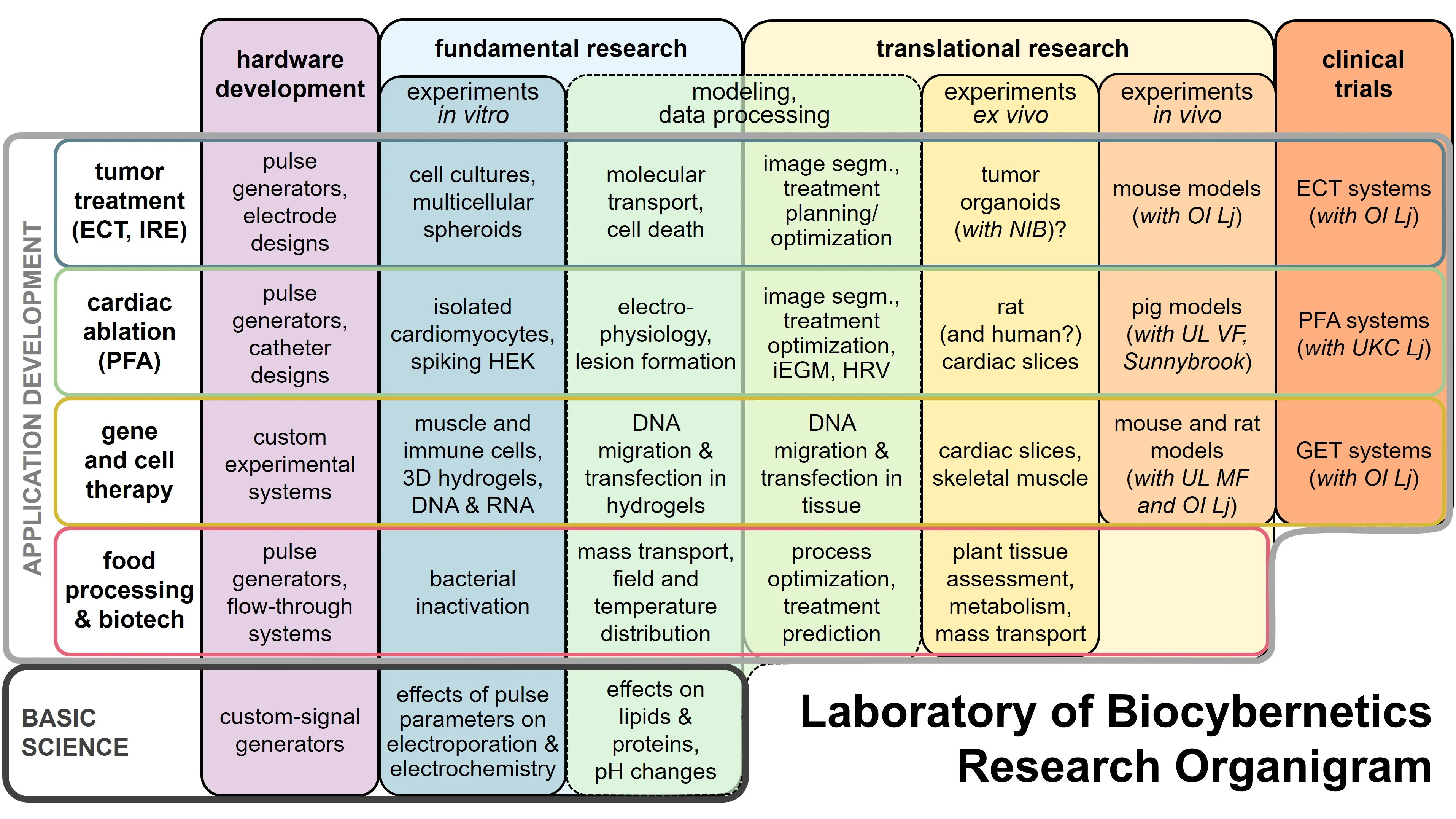
We study the electroporation phenomenon using both theoretical and experimental approaches, spanning scales from atomic-molecular (MD simulations), membrane-level (lipid bilayers and vesicles), organelle- and cell-level (cells in suspension, attached, and in 3D cultures), up to tissues and organs (animal studies in cooperation with the Veterinary Faculty of the University of Ljubljana and Sunnybrook Research Institute in Toronto, Canada). We also collaborate with medical institutions (Departments of Cardiovascular Surgery and Cardiology at the University Medical Centre Ljubljana, and Institute of Oncology Ljubljana) in clinical studies, and with national and international industrial partners in development of medical and experimental devices. Our work encompasses development of devices, fundamental and translational experiments and modeling, as well as treatment planning and development of information technology for clinical trials, and ranges from the studies of basic mechanisms to applications in oncology, cardiology, gene and cell therapy, as well as food processing and biotechnology. An organizational chart of the areas of our work is sketched below, while more detailed descriptions of our work in each field are available by following the links on the tab "Research".
Our publications on electroporation and its applications have so far received over 30 thousand citations. Since 2003 we have been organizing (first bi-annually, since 2011 annually) the workshop and postgraduate course Electroporation-Based Technologies and Treatments (EBTT), attracting each year over 50 attendees, and in total over 800 participants from over 40 countries. We were the chairs of the European network for development of electroporation-based technologies and treatments – COST Action TD1104 (2011-2016) connecting 581 researchers of electroporation from 243 research institutions and 28 companies from 43 countries. Professor Damijan Miklavčič, the research head of the laboratory, is the editor of the Handbook of Electroporation published by Springer, with the first edition released in 2017 spanning almost 3000 pages, and the second, updated and extended edition slated for publication in 2027.
 Damijan MiklavčičResearch programme leader
 Tadej KotnikHead of laboratory
 Tomaž JarmClinical translation
 Lea RemsComputational biophysics
 Matej ReberšekHardware development