
Research approach
Fundamental Experimental Research
The development of effective and safe electroporation-based technologies requires a deep mechanistic understanding of how cells and tissues respond to electric pulses.
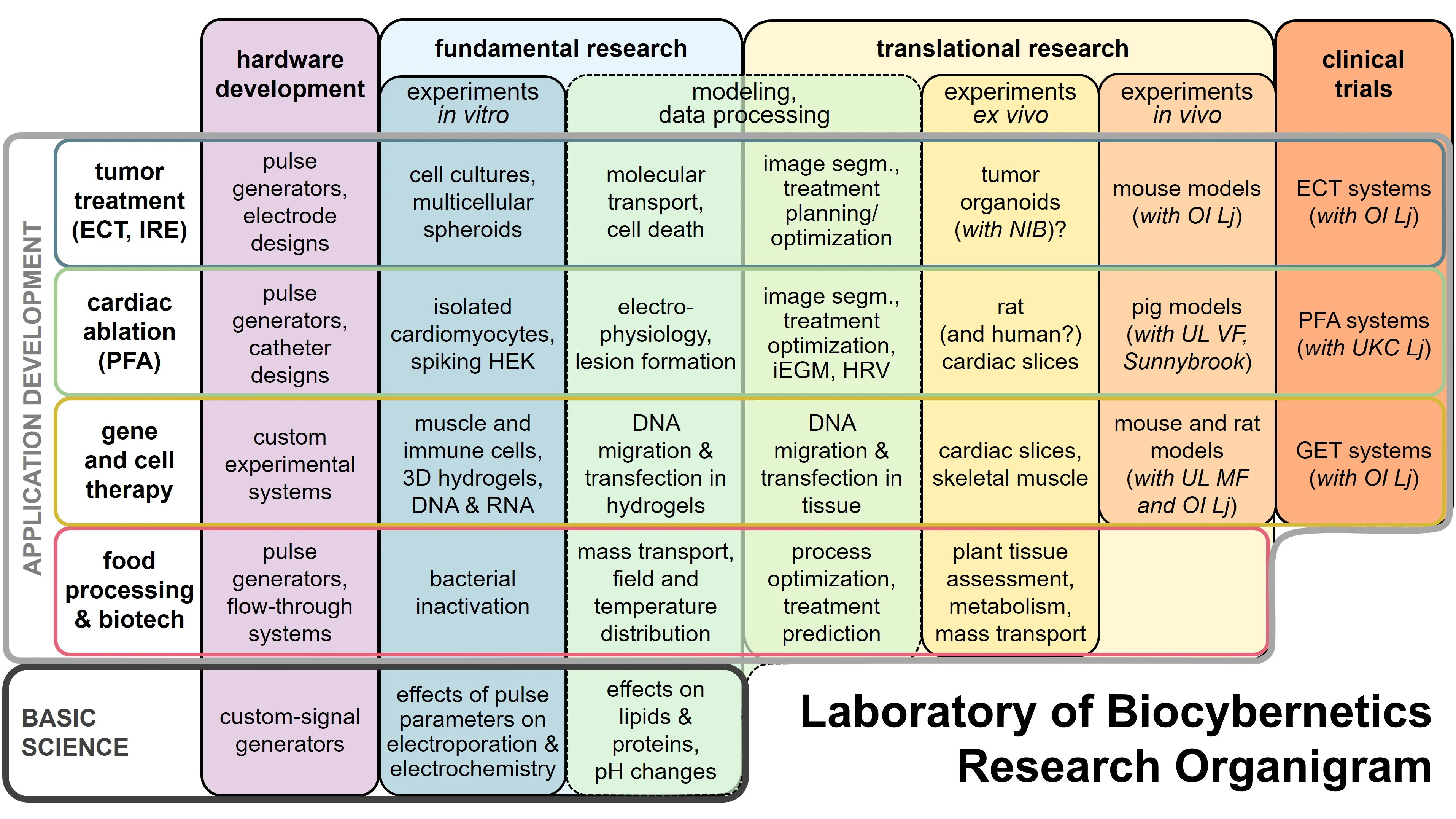
The development of effective and safe electroporation-based technologies and treatments requires a deep mechanistic understanding of how cells and tissues respond to electric pulses. At the Laboratory of Biocybernetics, we investigate fundamental questions that bridge the gap between applications in medicine, food and bio- technology, and their underlying biological mechanisms. Our research addresses the mechanisms of increased membrane permeability, the dynamics of cell death following electroporation, effects on cellular electrophysiology, requirements for successful gene electrotransfer, and broader changes in cellular responses including proliferation, invasion, stemness, release of damage-associated molecular patterns (DAMPs), and immunomodulatory effects. We also investigate interactions between electroporation and pharmacological agents as well as the effects of physical factors such as temperature and electrochemical reactions. To address these questions systematically, we employ a comprehensive set of experimental models, ranging from in vitro systems that provide highly controlled and reproducible environments to in vivo studies that capture the complexity of whole-organism responses. These experimental models include:
- various tumor and normal cell lines
- immune cells
- multicellular spheroids and organoids
- three-dimensional tissue mimics – hydrogels
- primary adult and neonatal cardiomyocytes
- myocardial slices
- skeletal muscle tissue
- plant tissue
- in vivo animal studies (in collaboration)
- bacteria
 Damijan MiklavčičResearch programme leader
 Tamara PolajžerCell death mechanisms
 Alenka Maček LebarMembrane biophysics